Facebook Built 39 Million Answer Pages. You Cannot Copy the Recipe
Meta's Facebook Answers pages took 40 million visits in October. The pages come from owned posts and an owned domain, not a page template you can copy.

Dilshad Akhtar
Published: 6 November 2026
5 min read
TL;DRAI summary
- Meta runs an estimated 39 million Facebook Answers pages ranking for at least one US keyword.
- Semrush puts October traffic on those pages at 40,590,906 visits worldwide.
- Google's spam policy calls mass page generation scaled content abuse, whatever writes the page.
- A brand can edit its own site page and its own posts, not the answer page.
- The traffic comes from owning the posts and the domain, not from the page template.
Meta runs a directory of AI written pages under facebook.com/fb-answers. Semrush estimates 39 million of them rank for at least one keyword in the United States alone. The same estimate puts worldwide traffic at 40,590,906 visits in October.
What Facebook built, month by month
Each page is a short summary built from posts other people wrote. Meta has published nothing about the directory. The pages keep ranking anyway.
The directory holds one page per question, and the questions run from card benefits to airport parking. Traffic grew faster than any content operation I have seen:
| Month | Worldwide visits, Semrush estimate |
|---|---|
| May 2026 | 129,514 |
| July 2026 | 1,032,527 |
| August 2026 | 12,167,857 |
| September 2026 | 36,388,769 |
| October 2026 | 40,590,906 |
Saul Westbrook broke the story on 5 November 2026 and pulled the numbers. He also noted the keyword count behind those pages. It went from 4 million in July to 53 million in August, and Google holds about 6 million of the pages in its index.
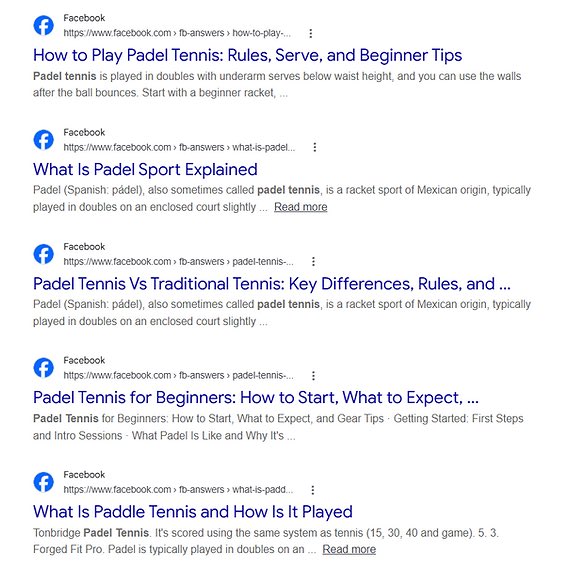
The detail that matters most is how little editing went into it. Westbrook found 180 English pages on Padel Tennis, a sport with a small search footprint. Nobody checks these pages before they go live.
Full write up: https://www.peripheralcreative.com/news/facebook-answers-ai-generated-pages
Facebook understands its a solid Google parasite and AI citation influencer.. Here they are implementing a traditional pSEO campaign to eat up tons of FAQ style searches.. Currently ranking 39 million pages in Google lmao
— Connor Showler | SEO & Marketing Master (@ConnorShowler) November 5, 2026
Why these pages survive and yours would not
Google's spam policy is public and blunt. Scaled content abuse covers a site that generates "many pages ... for the primary purpose of manipulating search rankings". It names generative AI tools as one way to break the rule, and it adds that the rule applies "no matter how it's created".
Read the policy: https://developers.google.com/search/docs/essentials/spam-policies
Westbrook points out that the pages came through the September spam update intact. I can't tell you why Google left them alone, and neither can he. What I can do is list what Meta had before it published a single page.
Meta owned the posts. Users have written on Facebook since well before 2010, and those posts are the source material for every summary. Meta owns a domain Google cannot demote without damaging its own results. Meta also owns the login, so a visitor who lands on one page becomes a session.
A small site has none of those three. That is the whole difference, and it has nothing to do with how clever the page template is.
One more piece Meta controls is the crawler that visits your site. Our guide on Facebookbot covers what it collects.
What one page actually contains
I opened a live page on 6 November 2026 rather than trusting a screenshot. The Amex travel page carries five headings of plain summary, and each claim leans on a named post.
Example: the Amex travel page
There is no byline, no publish date and no editor. A "More like this" block links to related pages inside the directory. Clickable sources sit under the summary.
That layout is the tell. The page is not written for a reader who arrived from a newsletter. It is written to survive one visit, collect a rating and pass the reader to another page.
The scale gap, in our own numbers
We publish a lot of pages. In the last 90 days our Search Console shows 22 page and query rows containing "programmatic seo", spread across 10 pages. The best of them took 97 impressions at position 63, with zero clicks.
For "scaled content abuse" itself we have no rows at all. Nobody finds us on that term.
That is the honest picture of publishing at our size. Adding pages changes the count. It doesn't change the position, because the missing ingredient is the source material readers already wrote.
Our guide on programmatic SEO risks covers what goes wrong when a site builds pages without that material.
What you can fix and what you cannot
Almost every brand now has a summary about itself somewhere in results. Very few of those summaries are editable. This table separates the work that responds from the work that does not.
| Surface | Who writes it | Can you change it | How |
|---|---|---|---|
| Your own site page | You | Yes | Edit the page |
| Your Facebook posts and comments | You | Yes | Post, correct, or add detail |
| A Facebook Answers page | A model, from its sources | No | Change the posts it quotes |
| An AI Overview citation | A model, from live results | No | Change the pages it quotes |
The one route worth using is the third row. Your posts are quoted as sources, and sources get clicked. A plain sentence about your opening hours on your page is likelier to be quoted than a logo.
What to check on your own name this week
Run this search: site:facebook.com/fb-answers "your brand". Set the location to the United States, because the measured traffic sits there.
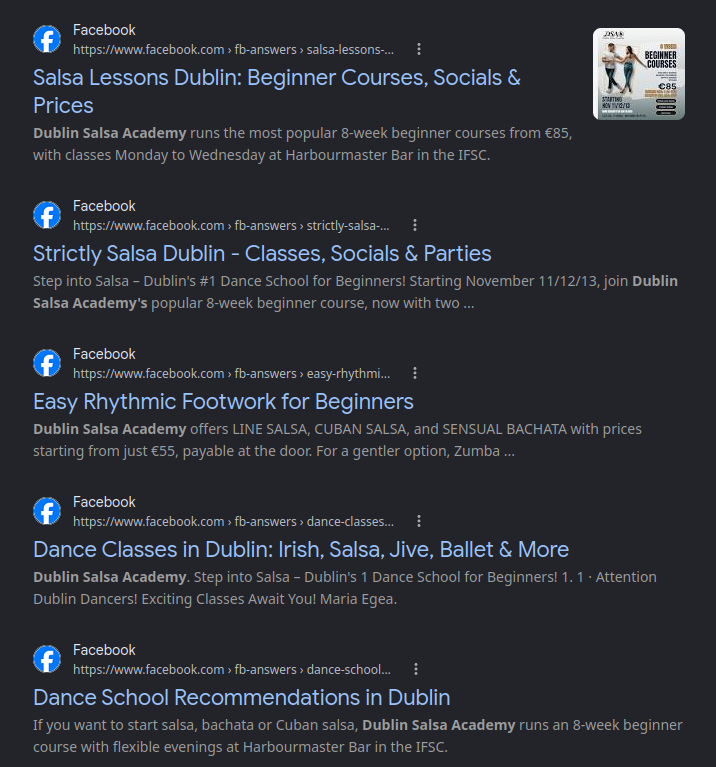
Open every page that mentions you and read the summary aloud. If a line is wrong, do not look for an edit button. There is none.
Then post the correction where the model reads. Put the right detail in a group post and in a comment under your own page. Say the fact in a full sentence, the way a person would write it.

Then compare the summary to your About page. If the two disagree, fix the About page first. That is the page you control.
One more check, and it costs nothing. Search your company name and see whether an answer page outranks you for your own name. That result tells you more than a rank tracker will.
The part nobody has measured
Every figure here is a Semrush estimate, and Meta has said nothing. The 40 million visits may fall next month. Google may act on the directory after the public attention.
Reddit shows what a shift looks like when it lands. Its estimated search traffic fell to 1.8 billion visits a month from a 2.3 billion peak. Its share price dropped 29 percent at the end of October.
So treat this as evidence, not a forecast. Meta got a large slice of informational search by owning the posts and the domain. The lesson for a smaller site is the reverse of the tactic everyone is sharing.
Do not build 39 million pages. Check what the pages already say about you, and give the model better sentences to quote.
If a wrong line about your company is sitting in results today, book a call and we will find it: book a call
Related Articles
Discover more insights about web development and digital marketing