Yandex and Baidu: Search Engines Outside the West, Complete 2026 Guide
Understand how Yandex and Baidu ranking diverges from Google, including their unique ranking signals, generative search rollouts, and how to run a regional search engine audit.
Dilshad Akhtar
Last updated: 11 July 2026
5 min read
TL;DRAI summary
- Yandex holds near 67% search share in Russia; Baidu near 66% in China
- Yandex Y3 transformer blends semantic embeddings with classical link-graph signals
- Baidu still struggles with client-side JavaScript rendering
- Mainland hosting with an ICP license is required for Baidu organic ranking
- Yandex prefers .ru domains, Cyrillic content, and server IP geolocation inside Russia
- Ernie-driven answer boxes pull 30% of clicks from top organic results in pilot categories
Yandex and Baidu command the majority of search volume in Russia and mainland China. Western SEO playbooks miss both engines, as Yandex weighs behavioral signals more heavily and Baidu barely indexes JavaScript-heavy pages.
Why Yandex and Baidu still matter in 2026
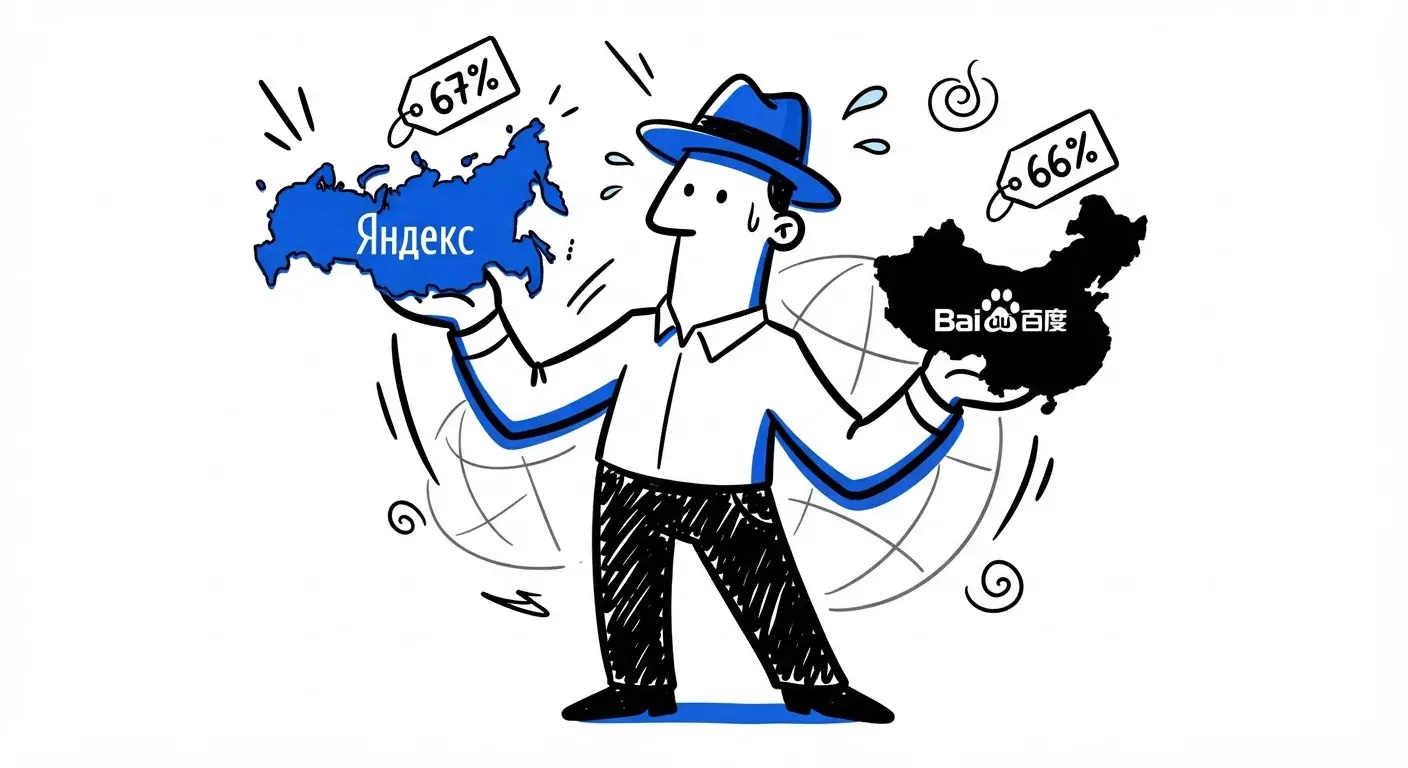
Yandex and Baidu still matter. They command the majority of search volume in Russia and mainland China across 2025. StatCounter's monthly averages put Yandex near 67% in Russia and Baidu near 66% in China (StatCounter).
Western SEO playbooks miss both. Yandex weighs behavioral signals like dwell time and click-through more heavily than Google. Baidu barely indexes JavaScript-heavy pages and imposes content hosting rules Google does not enforce.
Generative search reached both in 2025. Yandex expanded its Neural Search Y3 rollout mid-year. Baidu's Ernie-powered answer boxes began displacing organic results on informational queries through Q4 2025. The shift mirrors the Google AI Overview pattern but at different velocity across each regional market.
Generative result placement varies by query type in each engine. Per the Yandex technical documentation, the Y3 transformer surfaces above traditional blue links for 28% of informational queries as of late 2025. Per the Baidu coverage noted above, Ernie answer boxes dominate approximately 30% of informational queries in pilot categories.
How Yandex ranking diverges from Google

Yandex confirmed Y3 as a transformer-based ranker in 2025, per their technical documentation. It blends semantic embeddings with classical link-graph signals. Pure PageRank thinking breaks here.
Behavioral metrics carry weight. Yandex Metrica tracks user session quality, scroll depth, and bounce patterns, then feeds anonymized signals back into ranking, per Search Engine Journal's 2025 Yandex guide.
Localization depth matters more than on Google. Yandex prefers .ru domains, Cyrillic content, server IP geolocation inside Russia, and Yandex.Webmaster verification. A U.S.-hosted English page rarely ranks in Yandex regardless of backlinks.
Geo-targeting flags in Yandex.Webmaster replaced Google's hreflang in 2025 iterations. Mismatched geo signals trigger demotion within one to two crawl cycles. Tune before you scale content.
How Baidu ranking diverges from Google

Baidu indexing still struggles with client-side rendering. The crawler historically executes minimal JavaScript. Pages that rely on hydration for content discovery get partial indexes, per Baidu Webmaster Tools documentation.
Mainland hosting with an ICP license is a hard requirement for organic ranking. Pages served from overseas IPs land in lower result buckets. The licensing process takes 20 working days minimum.
Baidu weighs title tags, meta keywords, and on-page keyword density more than Google does in 2025. Tighter relevance ceiling. Exact-match anchors still outperform topical anchors for many commercial verticals.

Ernie-driven answer boxes pulled 30% of clicks from top organic results in pilot categories through late 2025, per South China Morning Post's November 2025 Baidu coverage. Restructure for citation or lose the position.
The regional search engine audit
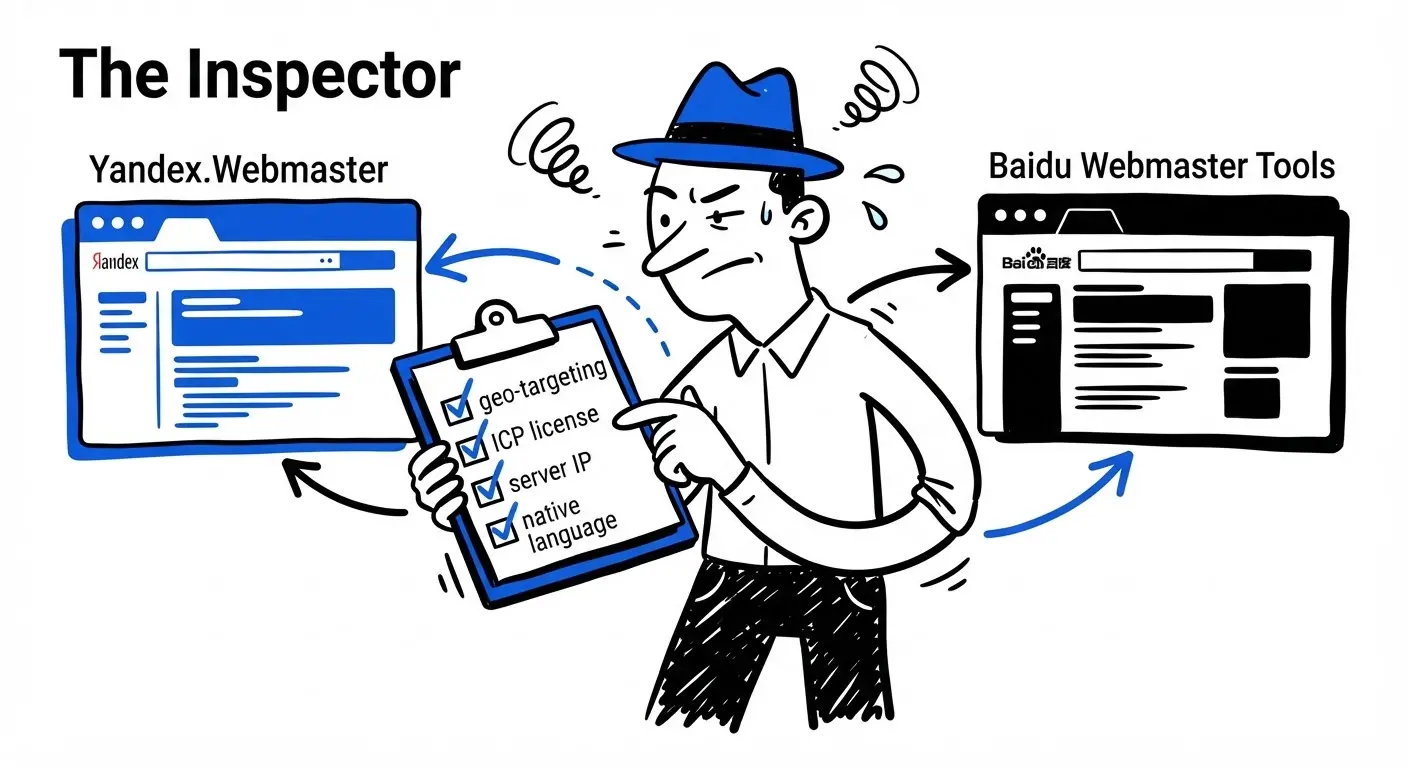
A regional campaign kicks off. You open Yandex.Webmaster and Baidu Webmaster in split windows. You check geo-targeting settings, ICP license status, server IPs, and hreflang equivalents before content ships a single page.
You verify crawl access. Both engines require explicit registration and DNS verification before they fetch staging environments at scale. Skip this and index coverage caps at 5-10% of submitted URLs.
You map content to native language. Auto-translated pages get classified separately in both engines, so user signals feed weaker ranking data. Russian and Simplified Chinese copy need native review on every page shipped.
You log limitations. Yandex exits grew harder after U.S. sanctions tightened in the recent past. Some Western analytics tools no longer report Yandex data cleanly. Plan for reduced visibility into the post-launch curve.
Related Articles
Discover more insights about web development and digital marketing