
Privacy-Focused Search Engines in 2026
Explore how DuckDuckGo, Brave Search, Startpage, and Ecosia operate, their market share, ranking quality, SEO implications, and how they compare to AI search engines.

Dilshad Akhtar
Last updated: 11 July 2026
5 min read
TL;DRAI summary
- Four privacy platforms collectively process 4-6% of global search queries
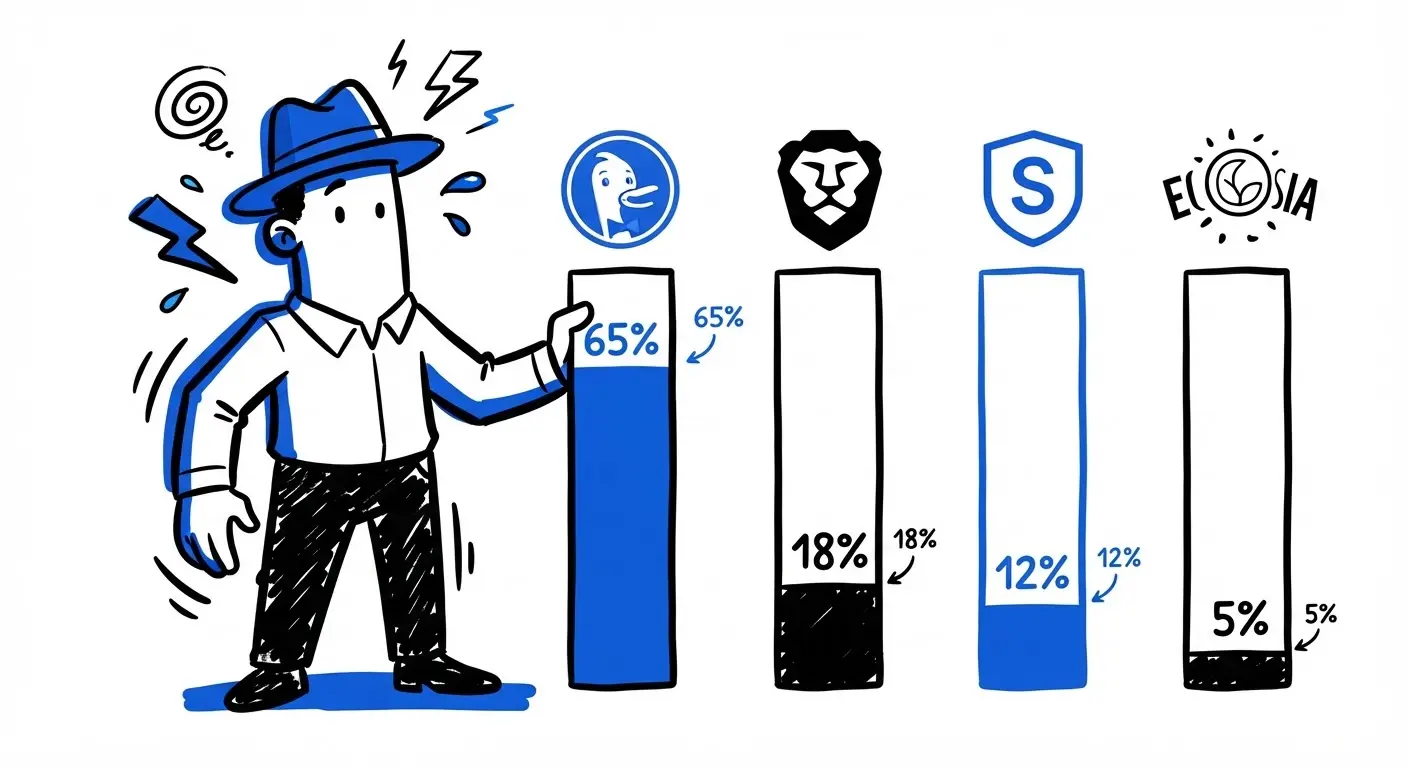
- DuckDuckGo leads the privacy segment at 65% share, Brave at 18%, Startpage at 12%, Ecosia at 5%
- Brave Search indexes approximately 30 billion web pages with its own crawler
- Privacy engines do not personalize results based on user history or location
- Ranking well in Google or Bing ranks well in most privacy engines
- Brave Search favors fast load times, structured data, and explicit semantic markup
Privacy-focused search engines return search results without tracking user behavior, building advertising profiles, or storing personal information. DuckDuckGo, Brave Search, Startpage, and Ecosia collectively process 4-6% of global search queries.
What privacy-focused search engines do
Privacy-focused search engines return search results without tracking user behavior, building advertising profiles, or storing personal information. The platforms fund operations through alternative revenue models: contextual advertising, paid-tier subscriptions, partnership deals, or non-profit donations.
DuckDuckGo, Brave Search, Startpage, and Ecosia are the dominant privacy-focused platforms in 2026. Per Privacy On's 2026 privacy search engine comparison, these four platforms collectively processed 4-6% of global search queries in 2025, with growth continuing through 2026.
Brave Search's documentation confirms the platform indexes approximately 30 billion web pages as of 2026 (Brave Search). Per Privacy On, the platform market share distribution in 2026 splits as DuckDuckGo at 65%, Brave at 18%, Startpage at 12%, and Ecosia at 5%.
The user base skews toward privacy-conscious demographics in Europe and North America. Per Factually's 2026 privacy search engine review, the user profile includes technical professionals, journalists, and consumers who have actively opted out of mainstream tracking-based search.
How privacy engines get results
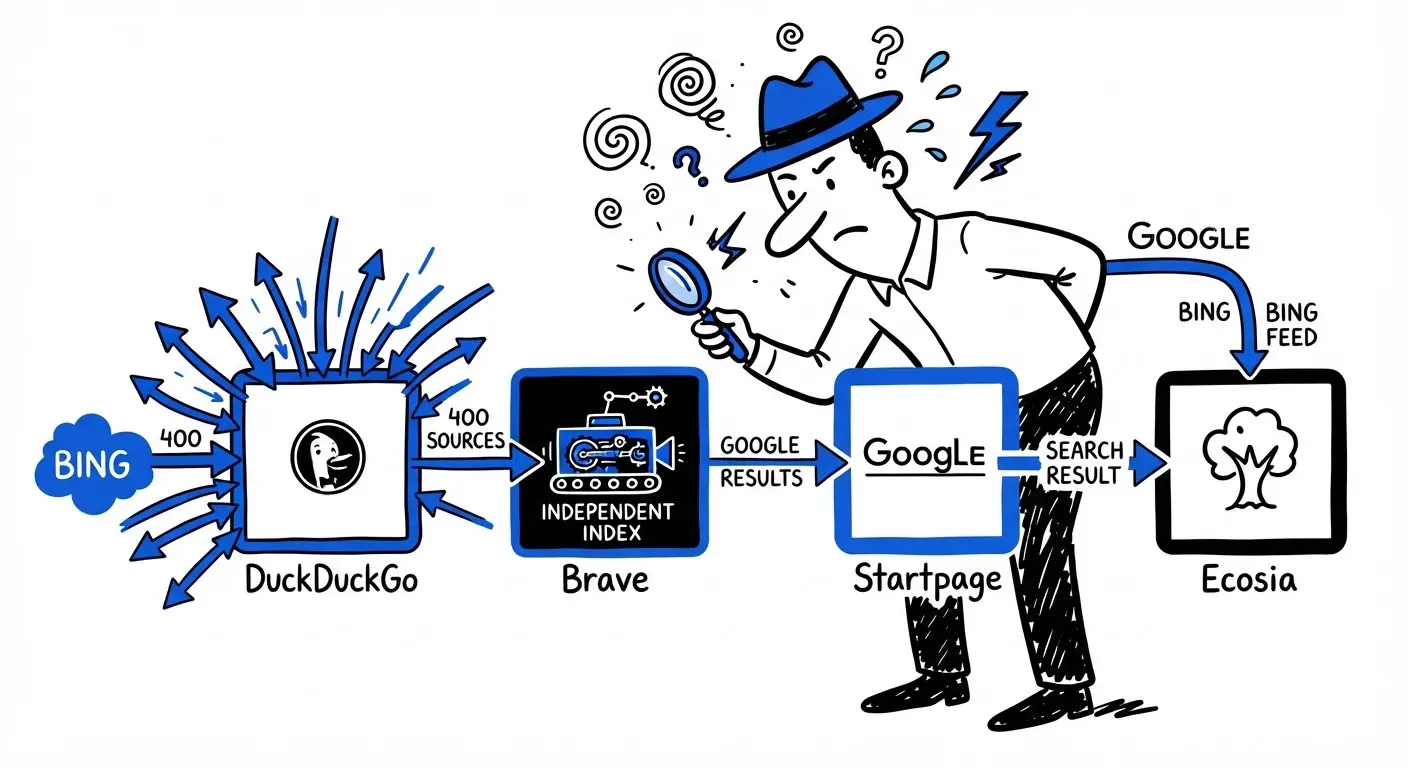
DuckDuckGo aggregates results from approximately 400 sources, primarily Bing, with supplementary sources from Wikipedia and independent crawlers. Brave Search operates its own index built from crawling the web.
Startpage returns Google results while stripping user identifiers. Ecosia uses Bing search results with revenue directed to tree-planting programs.
The ranking quality varies by platform. Per Privacy On's 2026 comparison, Brave Search's index produces results closest to Google's quality for general informational queries. DuckDuckGo's aggregated approach matches Google within 5-8% on most query categories. Startpage returns Google results directly when available, with quality parity to Google itself.
The trade-off is personalization. Privacy engines do not personalize results based on user search history or location. Per Privacy On's analysis, this produces slightly lower CTR on commercial queries but equivalent performance on informational queries versus Google.
The SEO implication of privacy search engines

Privacy search engines represent a small but growing share of search queries. SEO practitioners do not need to tune specifically for privacy engines since their results come from Google, Bing, or aggregated indexes. Ranking well in Google or Bing ranks well in privacy engines that aggregate from those sources.
Per Privacy On's analysis, DuckDuckGo pulls 95%+ of its results from Bing. Brave Search uses its own index but ranks based on signals similar to Google's. Startpage returns Google results. SEO work targeting Bing and Google covers privacy engine visibility.
The exception is Brave Search's independent crawler. Brave's index favors pages with fast load times, structured data, and explicit semantic markup. Brave's ranking signals correlate highly with Google's web ranking signals but use a different crawler architecture.
Privacy search engines vs AI search engines

Privacy search engines and AI search engines address different user concerns. Privacy engines focus on data protection. AI engines focus on answer synthesis. The two categories overlap in some platforms.
Brave Search offers both privacy and AI-generated summaries. DuckDuckGo offers AI summaries without tracking. Per Privacy On's 2026 comparison, hybrid platforms now dominate the privacy search segment.
The strategic choice depends on user priority. For users prioritizing data protection above answer synthesis, DuckDuckGo and Startpage win. For users prioritizing answer quality with privacy as secondary, Brave Search wins. For users prioritizing environmental impact, Ecosia wins.
The market share distribution reflects these priorities. Per Factually's 2026 review, DuckDuckGo leads the privacy segment at 65% share, Brave at 18%, Startpage at 12%, Ecosia at 5%. The distribution is stable across the 2025-2026 measurement window.
The privacy-first SERP pull

You open DuckDuckGo and search your top 20 commercial queries. You screenshot the SERP for each. You compare against Google SERPs for the same queries. You note differences in result order, featured snippets, and SERP feature presence.
You check Brave Search for the same 20 queries. You compare the index coverage against Google and DuckDuckGo. You note where Brave returns different results, since Brave's independent crawler may surface pages that Google does not.
Note the gap. This post synthesizes 2025 and 2026 data from three sources: Privacy On, Factually, and Brave Search's documentation. Two non-public privacy search ranking algorithm details remain unpublished. Replication required.
Privacy search engines are a small share of total queries but worth tracking. Audit quarterly for SERP parity shifts.
Related Articles
Discover more insights about web development and digital marketing