SEO vs SEM: What's the Difference and When to Use Each in 2026
SEM buys placement through real-time bids. SEO earns it through relevance and authority. Learn the channel split measurement and when each wins the quarter.
Dilshad Akhtar
Last updated: 11 July 2026
5 min read
TL;DRAI summary
- SEM buys placement through real-time bids; SEO earns it through relevance, authority, and technical accessibility
- Google Ads CPC averaged $5.42 across all 20 industries in 2025-2026 per WordStream
- SEO compounds past the click — median B2B ROI of 748% over three years per First Page Sage
- A healthy 2026 split is 60-70% organic sessions, 30-40% paid for established B2B sites
- Measure the split quarterly, reallocate every six months
SEM stands for paid search marketing. It covers text ads, shopping ads, Performance Max, and every auction-driven listing on Google or Bing. SEO owns the organic slots. Same screen, two budget lines.
What SEM means and how it differs from SEO
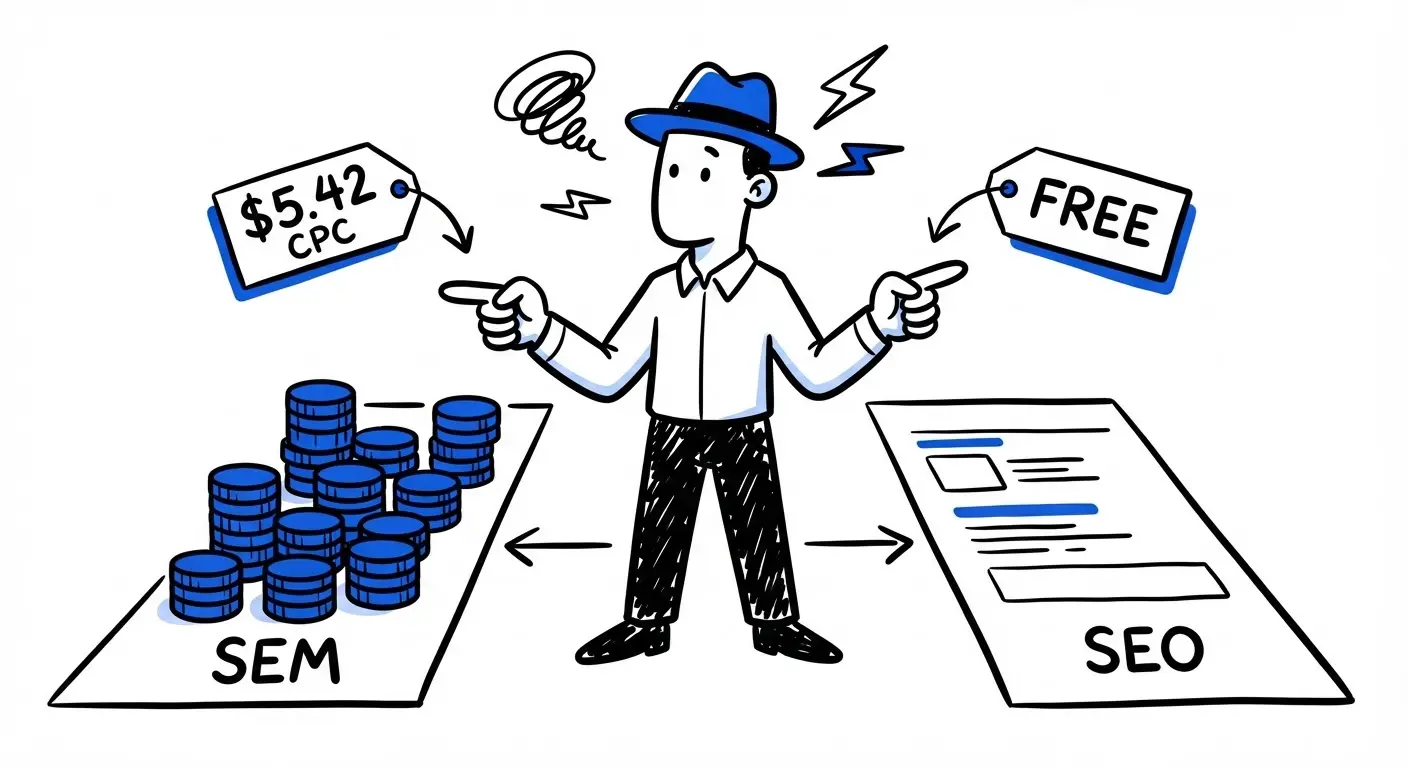
Google Ads cost-per-click averaged $5.42 across all 20 industries in the April 2025 to March 2026 WordStream benchmark, per Search Engine Journal. Organic listings cost nothing per click. The gap shows up in the annual media plan.
Both channels target the same queries. The split happens at the auction layer and the ranking algorithm. SEM buys placement through a real-time bid. SEO earns placement through relevance, authority, and technical accessibility. You can run both against the same keyword without conflict.
Cutting SEM produces an immediate traffic drop. Cutting SEO degrades rankings over months, often invisibly until the next quarterly review. SEM budgets reset monthly at the spend cap. SEO budgets accrue as content and links that compound year over year.
Where SEM wins on speed and intent
SEM traffic lands on day one. A new campaign with credit card on file can register impressions within hours. SEO requires crawl, index, and ranking cycles measured in weeks or quarters. For product launches and seasonal pushes, the speed delta dominates every other consideration.
SEM captures high-intent queries at the bottom of the funnel. WordStream's 2026 benchmark reports an 8.18% average conversion rate across Google Ads. SEM also handles negative keywords surgically: a B2B SaaS can exclude every "free" and "tutorial" query from paid campaigns. SEO cannot filter intent at query time.
Performance Max campaigns extended SEM into display and video inventory in 2025. The channel widened. Cost-per-lead average across industries hit $66.69 in 2025-2026, per WordStream. SEM now competes against social and programmatic for the same media dollars.
Where SEO compounds past the click
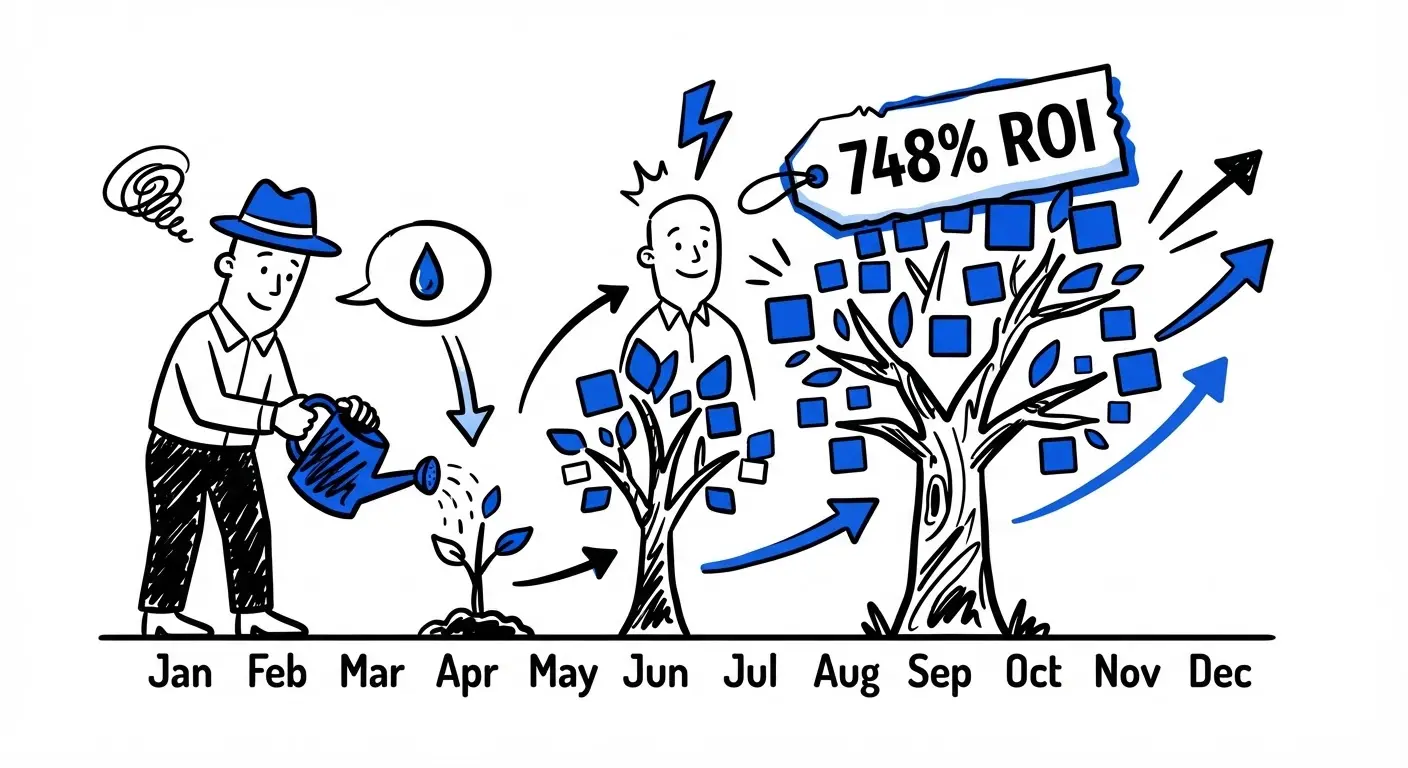
SEO assets accumulate. A page ranking on page one in January continues delivering traffic in July, often with reduced maintenance cost. The First Page Sage 2026 ROI report tracks a median B2B SEO return of 748% over three years. SEM rarely compounds past the active campaign window.
Organic close rates outpace paid. HubSpot data referenced by ClickVision's 2026 study shows organic search leads close roughly eight times more often than outbound leads. The trust signal is the position itself, not the brand bid.
AI Overviews changed the math on informational queries. Seer Interactive's April 2026 update found organic click-through rebounded 85% over two months on AI Overview queries. Publishers who restructured their content for citation surfaced in the new format.
 SEO cost per acquisition flattens over time. The first year carries content production, technical fixes, and link acquisition. Year two and three run on refresh cycles and incremental expansion. SEM cost per acquisition typically rises as auction competition intensifies around high-value keywords.
The channel split measurement
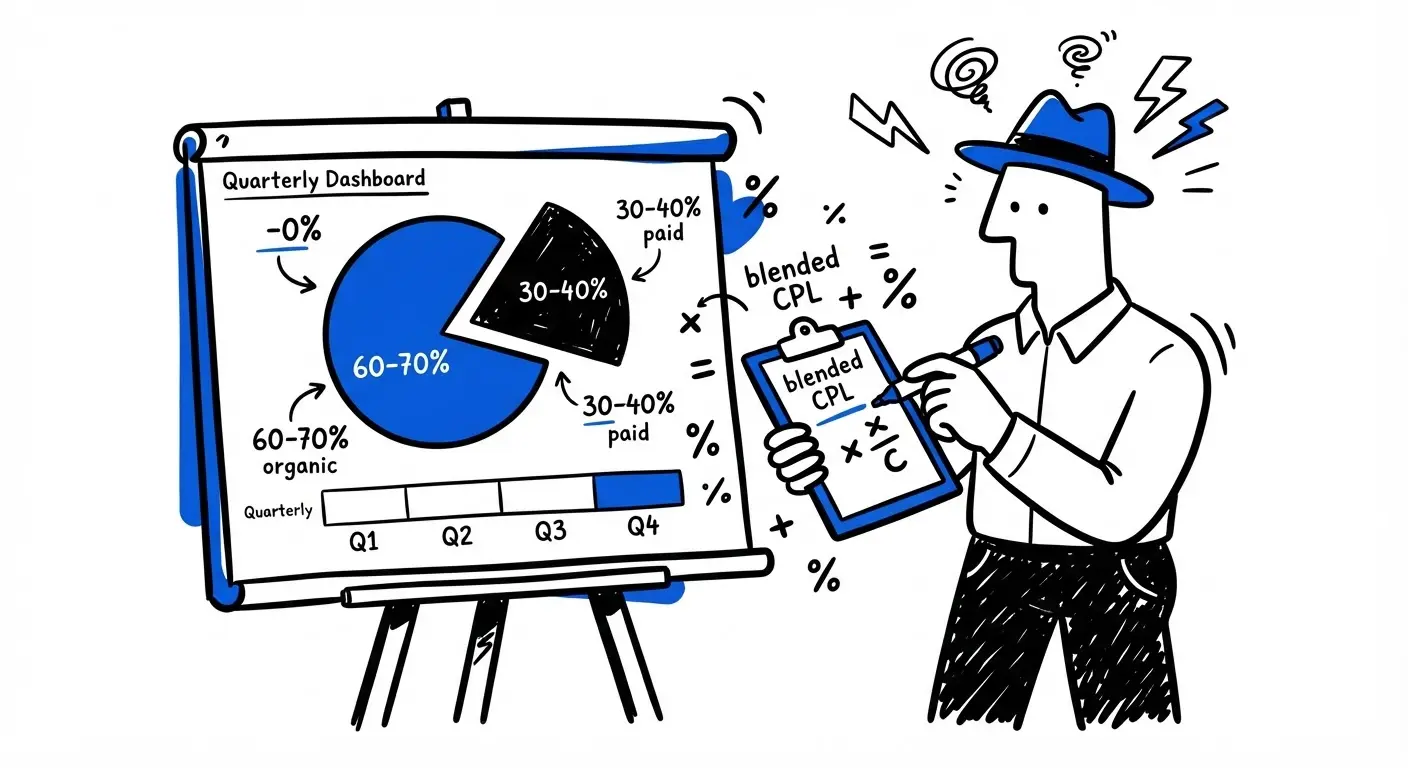
Quarter ends. You pull the channel attribution report from GA4 and your CRM. You split sessions, conversions, and pipeline value across organic search, paid search, and direct. You compare against last quarter's split and the budget allocated to each channel.
You benchmark your organic traffic against your paid click volume. A healthy split in 2026 looks like 60-70% organic sessions, 30-40% paid sessions for B2B sites with three or more years of SEO history. Newer sites invert the ratio until content compounds.
You calculate blended CPL. Add organic CPL to paid CPL ($66.69 industry average per WordStream 2026). Compare against customer acquisition cost by channel. The split informs the next quarter's budget allocation, not the next campaign brief.
You mark the queries each channel owns. High-intent commercial terms run on SEM. Educational and comparison queries run on SEO. Brand defense runs on both. The split lives in a shared doc, not in a single attribution model that hides the mechanics.
Note the gap. This post synthesizes data from five sources: First Page Sage, WordStream by LocaliQ, Search Engine Journal, ClickVision, and Seer Interactive. Multi-touch credit across organic and paid touchpoints still varies by CRM. Measure the split quarterly. Reallocate every six months.
Related Articles
Discover more insights about web development and digital marketing